

Water on the Chain
Centerville Lake Water Clarity After Alum: What Changed
For years the algae was the first question on Centerville. Here's what the watershed did about it, what it cost, and how much clearer the water is now.
Short answer: Centerville Lake is close to four times clearer than it was before the alum treatment. Summer clarity averaged about 0.6 meters, roughly 2 feet, every year from 2017 to 2023. It rose to 1.6 meters in 2024 and reached 2.3 meters, about 7.5 feet, in 2026, the highest summer mean on record since 1975, per the Minnesota Pollution Control Agency. The Rice Creek Watershed District applied alum in May 2024 and spring 2026 and expects better water for 15 to 20 years. The lake is still on the state's impaired list until monitoring over several summers shows it meets the standards.
If you've looked at a house on Centerville Lake in the last ten years, somebody warned you about the algae. A neighbor, an agent, a friend who fished it once in August. It was a fair warning. It's also out of date.
For years, the algae question came up at almost every Centerville showing I did. Now it has a better answer, and it's in the numbers.
What changed after the alum?
The water got a lot clearer. Secchi depth is how far down you can still see a white disk. Higher means clearer. Here are the Minnesota Pollution Control Agency's summer means for Centerville Lake, July 20 to September 20:
- 1975: 1.0 meters
- 2000: 0.4 meters, the low point
- 2017 to 2023: 0.5 to 0.6 meters every summer, about 2 feet
- 2024, after the first alum: 1.6 meters
- 2025: 1.3 meters
- 2026, after the second alum: 2.3 meters, about 7.5 feet
That 2026 number is the highest summer mean on record since 1975. Going from 0.6 to 2.3 meters is close to four times clearer. Chlorophyll-a, which measures algae, fell sharply in 2024 and 2025. The state's clarity standard for this lake is 1.4 meters. Centerville beat it in 2024 and 2026, and came in just under it in 2025.
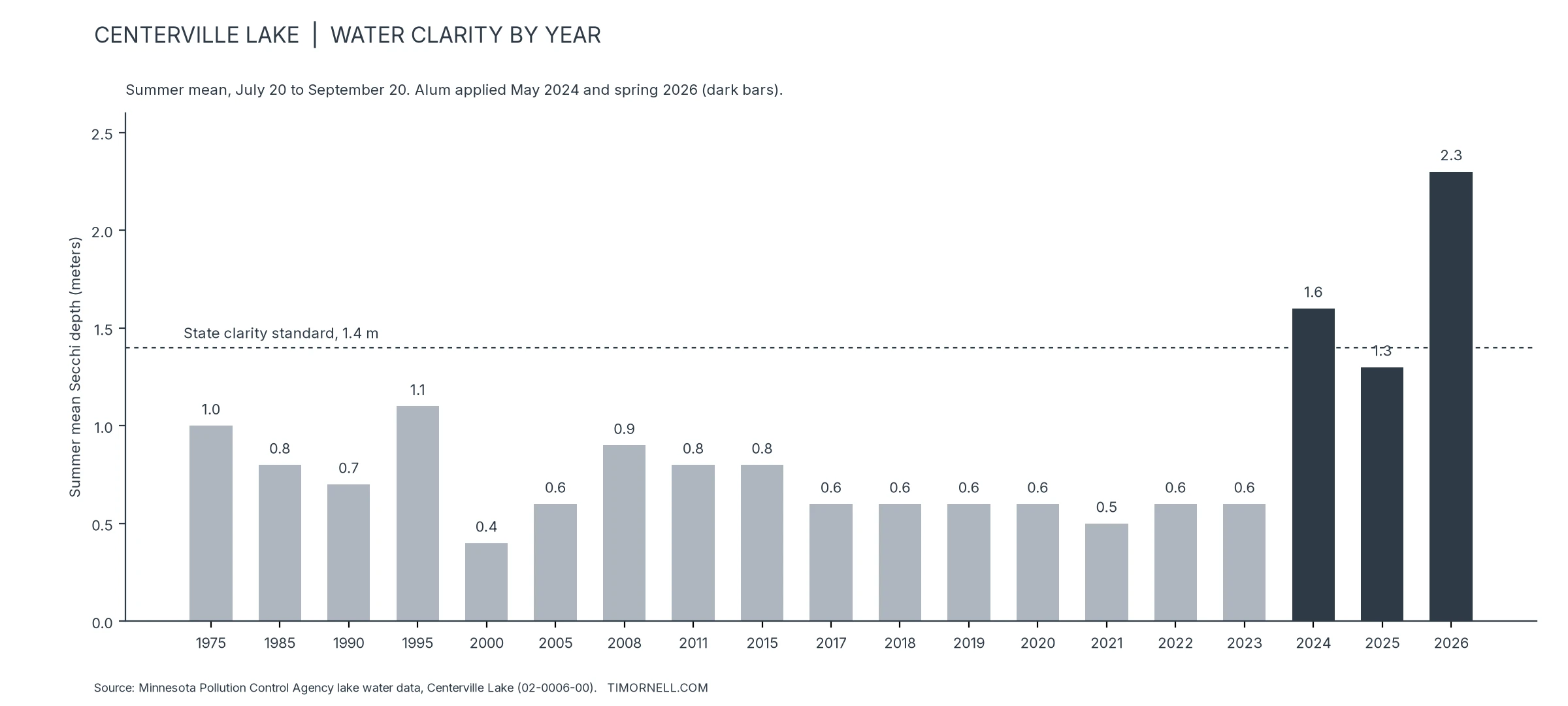
From about 2 feet to 7.5 feet. The clearest Centerville summer on record since 1975.
Here's how it got there.
What was wrong with Centerville Lake's water quality?
Too much phosphorus, which feeds algae. The lake is listed as impaired for excess nutrients, phosphorus and chlorophyll-a, according to the Rice Creek Watershed District.
The state's Legacy project record is blunt about it. Average summer phosphorus and chlorophyll-a ran about double the state standards. Facilities at the Rice Creek Chain of Lakes Park Reserve were often closed over blue-green algae.
For context, the DNR lists Centerville at about 474 acres, 19 feet at its deepest and 12 feet on average (DNR LakeFinder).
Why didn't fixing runoff solve it?
Because most of the phosphorus was already in the lake.
Most people assume lake algae comes from runoff: lawn fertilizer, street dirt, everything the rain washes in. RCWD and its partners spent years on that side. Stormwater ponds, rain gardens, street sweeping and a stormwater reuse project. Per the Legacy record, the water stayed murky and the blooms kept coming.
So RCWD studied it. Those studies found the main source was internal phosphorus loading, meaning phosphorus stored in the lake bottom was being released back into the water every summer to feed the next bloom. You can clean up every street in the watershed and it won't touch that.
You can clean up every street in the watershed and it won't touch phosphorus that's already in the lake bottom.
What is the Centerville Lake alum treatment?
Alum is aluminum sulfate. RCWD's project FAQ explains it this way: when alum hits the water it forms a fluffy material called floc. As the floc settles, it binds phosphorus and forms a layer on the bottom that keeps phosphorus from getting back into the water.
RCWD says alum has been used on lakes in the U.S. and Europe for decades. Its FAQ says there are no swimming restrictions, and the health risk from alum is very low.
When was Centerville Lake treated?
In two phases, per the Rice Creek Watershed District project page:
- May 14 to 21, 2024: Phase one. The contractor, SOLitude Lake Management, applied nearly 200,000 gallons of alum, about 26,000 gallons a day.
- Spring 2026: Phase two, scheduled to start in late April and wrap up before the May 9 fishing opener.
- June 30, 2026: RCWD reported the project complete, on schedule and under budget.
How much did it cost and who paid?
About $1,057,000, per the RCWD project page. The state's Clean Water Fund put in $954,500, according to the Legacy record. RCWD lists its partners as the City of Centerville, the City of Lino Lakes, Anoka County, Anoka County Parks and Rec, and the Centerville Lake Association.
How long will the alum treatment last?
RCWD expects it to improve water quality for about 15 to 20 years. The project is designed to control 178 pounds of phosphorus a year at first and 2,637 pounds over a 22-year life. RCWD's FAQ notes Centerville doesn't get much phosphorus from outside the lake, which helps the treatment last.
One thing owners should expect: more plants. RCWD's FAQ says clearer water will support the regrowth of native aquatic plants, which help keep the water clear. If you want to know what you can clear in front of your dock, see what you can and can't clear in front of your lake home.
RCWD's own FAQ says alum may not fix every water quality issue, and that ongoing monitoring, shoreline restoration and stormwater work are still needed to keep the water good.
Is Centerville Lake still impaired?
On paper, yes. The MPCA has listed it for excess nutrients since 2002. Getting off the list takes monitoring data that shows the lake meets all three state standards, phosphorus, algae and clarity, over time. RCWD says that once the project is done, the lake should finally meet them. Bald Eagle Lake went through the same steps and came off the list in 2024. RCWD keeps sampling every two weeks in summer and surveys plants each year.
Has alum worked on other north metro lakes?
Yes. Bald Eagle Lake is the closest example. RCWD treated it with alum in spring 2014 and 2016. Per RCWD's Bald Eagle project page, phosphorus dropped 67%, algae growth dropped 69% and water clarity improved 63%. Clarity went from about 5 feet or less in 2001 to 2008 to a maximum of 16 feet after the second treatment. In 2017, Bald Eagle met state standards for nutrients, algae and clarity for the first time since 1980, and in 2024 it came off the state's impaired list (RCWD 2025 annual report).
That's not a guarantee for Centerville. Every lake is different. But it's the reason people up here take alum seriously. For more on that lake, see my Bald Eagle Lake guide.
What about Peltier and Reshanau?
Centerville, Peltier and Reshanau are part of the same chain, and buyers used to shop them as one thing. They're not one thing anymore. Centerville has had its in-lake treatment. RCWD's summer 2026 update says it's planning a pilot project on Peltier in 2027 to test ways to improve water quality there. Each lake has its own story, so check each one on its own.
Centerville is one of three boating lakes in the chain, with Peltier and Reshanau. It isn't connected to the other two by boat. Its water flows naturally downstream to Peltier. For more on that and the rest of what to know before buying on Centerville, see my Centerville Lake guide.
What does this mean if I own or I'm buying on Centerville?
If you own on Centerville, the algae objection has a real answer now. For years the honest response was "the watershed is working on it." Now it's a completed public project with a cost, a completion date and a published plan. That's a different conversation with a buyer. If you're thinking about selling, start here.
If you're buying on Centerville, understand the clock. Fifteen to twenty years is a long runway. The phosphorus is locked down, not gone, so keeping it that way depends on everyone around the lake keeping fertilizer and runoff out. Ask how the water looked last August. And watch for RCWD's monitoring results.
What strikes me most is how unglamorous the work was. Street sweeping. Rain gardens. Years of sampling before anyone put a boat on the water with alum in it. Nobody cuts a ribbon for street sweeping. It's also why the conversation about this lake has changed.
Centerville Lake water quality FAQs
- Is Centerville Lake clean?
- It's much clearer than it was. Summer clarity averaged about 0.6 meters, roughly 2 feet, from 2017 to 2023. After alum treatments in May 2024 and spring 2026, it reached 2.3 meters, about 7.5 feet, in summer 2026, the highest summer mean on record since 1975, per the Minnesota Pollution Control Agency. The lake is still on the impaired list while monitoring continues.
- Why did Centerville Lake have algae blooms?
- Mostly phosphorus released from the lake bottom. Rice Creek Watershed District studies found internal phosphorus loading, meaning sediment releasing stored phosphorus each summer, was the primary nutrient source. Years of runoff projects like stormwater ponds, rain gardens and street sweeping didn't stop the blooms because they couldn't reach the phosphorus already in the lake.
- What is an alum treatment on a lake?
- Alum is aluminum sulfate. When applied to a lake, it forms a fluffy material called floc that binds phosphorus as it settles. The floc then forms a layer on the lake bottom that keeps phosphorus from releasing back into the water to feed algae, according to the Rice Creek Watershed District. It has been used on lakes in the U.S. and Europe for decades.
- When was the Centerville Lake alum treatment done?
- In two phases. Phase one ran May 14 to 21, 2024, when the contractor applied nearly 200,000 gallons of alum. Phase two was applied in spring 2026, scheduled to finish before the May 9 fishing opener. The Rice Creek Watershed District reported the project complete on June 30, 2026, on schedule and under budget.
- How long does the Centerville Lake alum treatment last?
- The Rice Creek Watershed District expects improved water quality for about 15 to 20 years. The project is designed to control 178 pounds of phosphorus a year at first and 2,637 pounds over a 22-year life. RCWD notes the lake gets relatively little phosphorus from outside, which helps the treatment last, but ongoing watershed work still matters.
- How much did the Centerville Lake alum project cost?
- About $1,057,000, according to the Rice Creek Watershed District. Minnesota's Clean Water Fund provided $954,500 of that, per the state's Legacy project record. RCWD's listed partners were the City of Centerville, the City of Lino Lakes, Anoka County, Anoka County Parks and Rec, and the Centerville Lake Association.
- Can you swim in Centerville Lake after the alum treatment?
- Yes. The Rice Creek Watershed District's project FAQ says there are no restrictions on swimming after alum, and the health risk from alum is very low because it sinks to the bottom quickly. Blue-green algae blooms are a separate health issue. If you see a bloom on any lake, stay out of it and keep pets out too.
- Is Centerville Lake still on the impaired waters list?
- Yes, as of November 2026. The MPCA has listed it as impaired for excess nutrients since 2002. The Rice Creek Watershed District says the lake should meet state nutrient standards once the project is complete. Coming off the list depends on monitoring data showing the lake meets those standards over time. Bald Eagle Lake, treated the same way, came off the list in 2024.
- Did alum work on Bald Eagle Lake?
- Yes. The Rice Creek Watershed District treated Bald Eagle Lake with alum in 2014 and 2016. RCWD reports phosphorus dropped 67%, algae growth dropped 69% and clarity improved 63%. In 2017 Bald Eagle met state standards for nutrients, algae and clarity for the first time since 1980, and it came off the impaired list in 2024. Results on one lake don't guarantee another.
- Does the alum treatment help home values on Centerville Lake?
- No one has published data on that yet, so I won't put a number on it. What it does is give sellers a documented answer to the algae question: a finished public project with a cost, dates and a monitoring plan. For buyers, look at RCWD's monitoring results as they come out, and judge the water on the lake itself.
A note from Tim
I've spent a lot of time on Centerville, Peltier and Reshanau, and the algae used to be the first thing people asked about. It's good to finally give them a real answer with dates and dollars behind it. I'll keep watching the monitoring results and I'll update this page when RCWD posts them. If you own on the chain or you're thinking about buying, reach out and I'll walk you through what I know about the water on a specific stretch.
Tim Ornell is a Realtor with Real Broker's Luxury Division who works with lakeshore homes across the north and east Twin Cities metro. More about Tim.

Tim Ornell | Real Broker Luxury Division
A note
from Tim
The Centerville Lake page has the clarity chart and the alum dates. If you want those numbers on a particular shore, reach out.
Best, Tim
Tim Ornell | Realtor, Real Broker Luxury Division | 651.263.9480 | timornell.com | [email protected]
Sources
All links opened and checked November 20, 2026.
- Rice Creek Watershed District, Centerville Lake Alum Treatment (primary source for dates, amounts, cost, partners and goals; updates through June 30, 2026)
- Rice Creek Watershed District, Centerville Lake Alum Treatment FAQ (PDF)
- Minnesota's Legacy, Centerville Lake Internal Phosphorus Load Reduction Project (Clean Water Fund, $954,500)
- Rice Creek Watershed District, Bald Eagle Lake Alum Treatment
- Rice Creek Watershed District, What's New: Summer 2026 (Peltier pilot, Centerville completion)
- Minnesota DNR LakeFinder, Centerville Lake (DOW 02000600)
- Minnesota Pollution Control Agency, Centerville Lake (02-0006-00) lake water data, summer mean Secchi depth July 20 to September 20, 1975 to 2026, and chlorophyll-a trend
- MPCA monitoring data, Centerville Lake stations, summer phosphorus 2021 to 2023, via the Water Quality Portal, retrieved November 20, 2026
- MPCA Surface Water, Centerville Lake 02-0006-00
- MPCA, Peltier-Centerville Lakes TMDL report (listing year and eutrophication standards)
- Rice Creek Watershed District, 2025 Annual Report (Bald Eagle delisting)